Normal POS receipts
Receipts without customer e-Invoice demand can be prepared for consolidated submission.

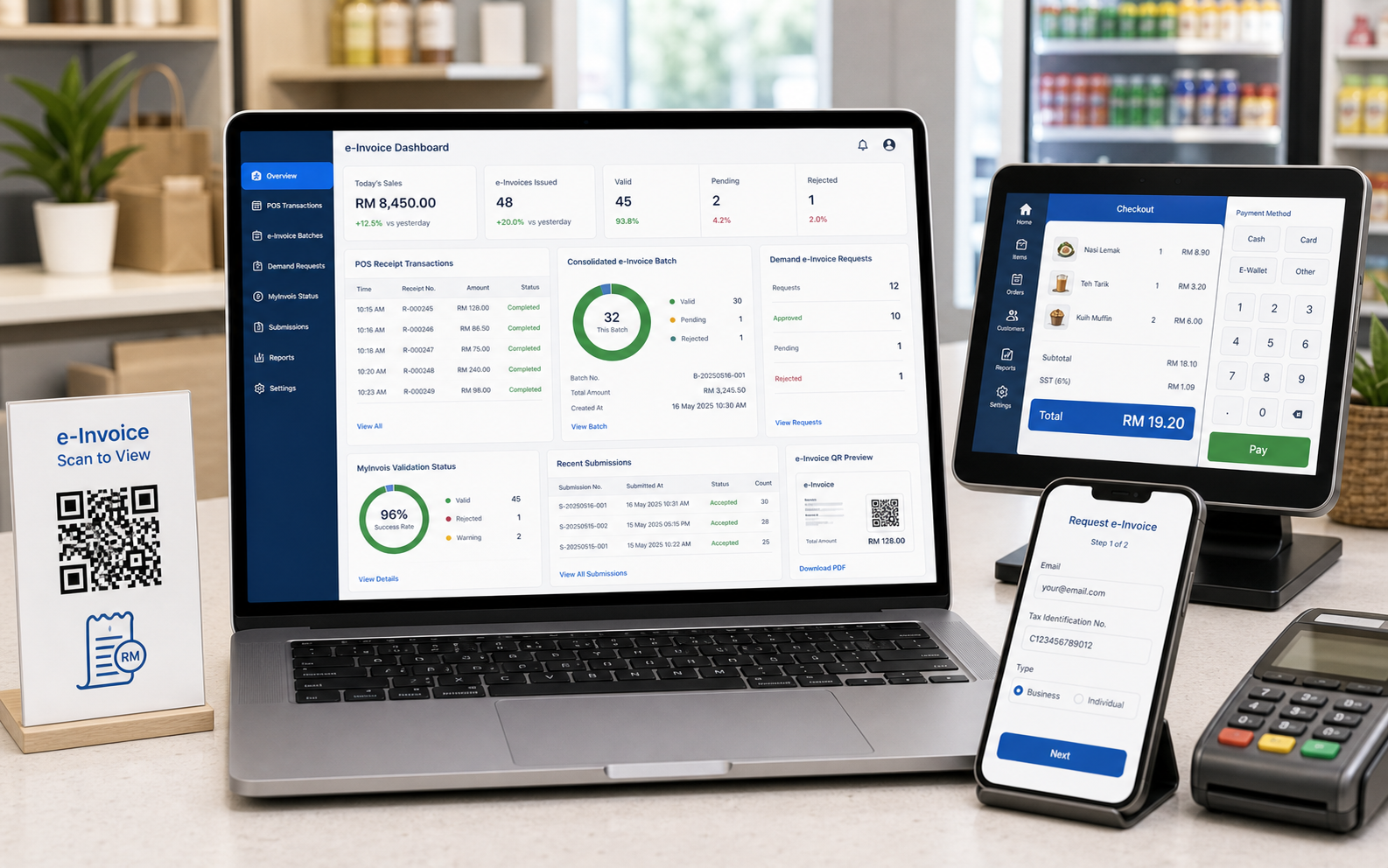
For Receipts Where The Customer Does Not Request an Individual e-Invoice, POS Web and Hybrid POS Can Prepare Consolidated e-Invoice Submission Workflow While Excluding Demanded Receipts.
| Class | Description | Qty | Total |
|---|---|---|---|
| 004 | Receipt R-10231 | 1 | RM75.00 |
| 004 | Receipt R-10232 | 1 | RM125.00 |
| 004 | Receipt R-10234 | 1 | RM145.00 |
| 004 | Receipt R-10235 | 1 | RM88.00 |
Consolidation is for eligible receipts where the customer has not demanded an individual e-Invoice. The key is to separate exceptions before preparing the batch.
Receipts without customer e-Invoice demand can be prepared for consolidated submission.
Receipts with online demand form requests should be excluded to avoid double submission.
The consolidated invoice can be auto-submitted through the supported workflow or exported for manual upload where required.
This is The operational Workflow For POS Teams And Accounts/admin Staff.
POS Web or Hybrid POS stores receipt transactions for the period.
Receipts demanded through online form are excluded from the consolidated batch.
Eligible normal receipts are grouped into one consolidated e-Invoice document.
Admin can auto-submit through BMO Cloud flow or manually upload the consolidated report where required.
Many SMEs have high receipt volume but only some customers request an individual e-Invoice. Consolidated e-Invoice helps keep normal receipt handling practical.
Tell us your POS setup and receipt volume. We can recommend the right consolidated e-Invoice flow and demand exclusion process.
Tell us your business type and outlet count. We will send pricing and arrange a walkthrough - no obligation.